Day Lewis director: Percentage margin ‘no longer the right measure of performance’
Arthur Walsh,
21 Sep 2026 3 Min
3 Min

Arthur Walsh,
21 Sep 20263 Min
Arthur Walsh,
21 Sep 20263 Min


Independent pharmacies should focus on metrics other than the percentage margins they achieve through NHS dispensing, Day Lewis Pharmacy joint chief executive Sam Patel has said.
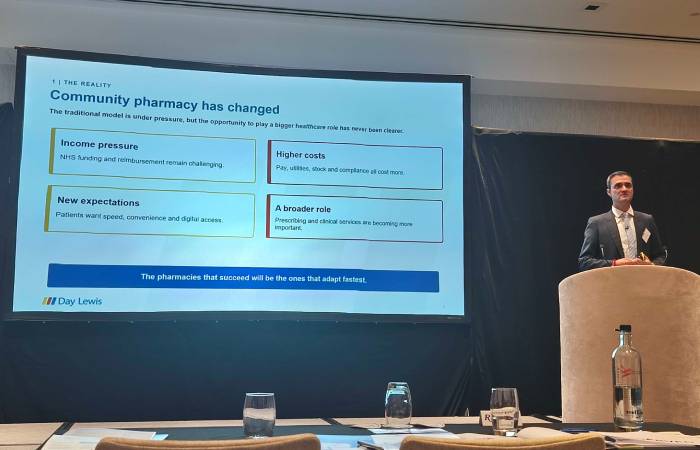
Addressing the Avicenna conference in London yesterday (September 20), Mr Patel said that while all pharmacies “should be thinking about their margins and their money,” percentage margin “is no longer the right measure,” commenting that it’s “absolute nonsense” to suggest a pharmacy with 40 per cent purchase margin is necessarily doing better than one with 28 per cent margin.
He added: “Even at Day Lewis, where we buy essentially all of our medicines across the whole estate, the percentage margin varies from our best to our worst pharmacies by as much as 15 per cent – huge variation.”
Dispensing offers “much less” margin than services, Mr Patel said: “If I have a pharmacy and I decide tomorrow not to dispense a single item next month and just do blood pressure checks, what will my margin be? 100 per cent.
“So if you're doing 15,000 items, you're going to have a lot lower gross profit than if you're doing 5,000 items, because a bigger proportion of your revenue is made up through dispensing.”
Branded generic dispensing and prescription durations are also factors that can affect margins,, he said. “You might have 8,000 items and high revenue because of branded turnover. It’s great for your goodwill if you’re measuring goodwill on a percentage-of-turnover basis, but it’s not great for your percentage margin, depending on your branded generics spend.
“The question is, what is the right thing to look at?
“The key thing to look at is your cash contribution per item.
“You take your reimbursement less the discount deduction, cost of drugs, measure it at the stock take... and divide that by your items.
“If you've got a regular period of treatment, there should be about 85p per item. That's you getting your fair share of the contract.
“High period of treatment might be about a pound. If you've got a low period of treatment, lots of seven day scripts and lots of 28 day scripts, you might be as low as 60p.
“That's what you should be looking at.
“And then the other metric to look at is your payroll per item. So when I look at our joint venture pharmacies, which we operate best in class, exclude the pharmacist and the locum. Just looking at the team and the driver, you really should be at 90p to £1 per item. That’s a really good benchmark to be thinking about.”
He said that while services “are now the new priority,” protecting dispensing “is critical,” describing the current community pharmacy model as an “aeroplane with two engines – they’re both needed to fly the plane”.
Mr Patel added that in the last 20 years “we've seen a dramatic reduction in the gap of buying power between large chains and independence,” which he attributed to “excellent cascade systems”.
He also advised contractors to “preserve optionality,” explaining: “Don’t lock yourself into something that could be painful later. If I'm taking a new lease on a pharmacy, I would rather pay 2,000 pound extra rent, but make sure that I've got break clauses every three to four or five years than a 15 year long lease that might be trapped if the business model moves because NHS moves or the industry moves.”